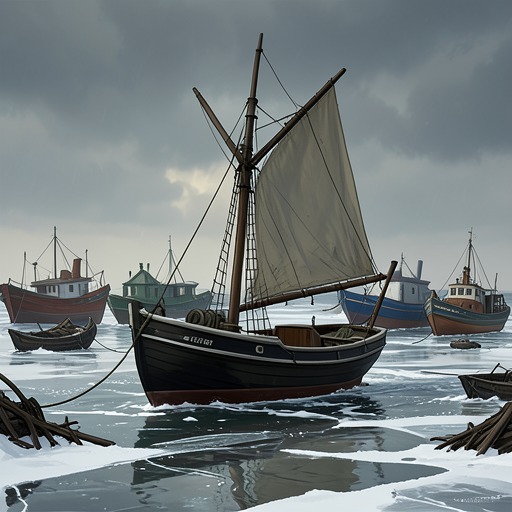
The Decline of Greenland’s Whaling Industry
The North WaterThe Decline of Greenland’s Whaling Industry is the commercial and ecological pressure behind the voyage of the Volunteer. The book presents an industry caught between dwindling returns from traditional whaling and an energy market turning toward petroleum and coal gas. As whales become harder to locate and pursue, the trade requires more powerful ships, specialized weapons, and journeys into dangerous ice. Brownlee hopes that skill and persistence can restore its fortunes; Baxter treats the decline as a reason to seek profit elsewhere.
A changing market
Baxter measures the contraction against a remembered era of easier returns. Thirty years earlier, he recalls, even an ordinary boat with a harpoon might make a fortune. He points to the Aurora, which returned in June with large quantities of whalebone aboard. In his account, the trade then sustained twenty-five profitable years, but that period has passed: the whales have been heavily depleted, and customers no longer want whale oil now that petroleum and coal gas are available. His history is both a diagnosis of changing demand and a blunt acknowledgment that the industry’s profits depended on extracting a resource until the old scale of returns could no longer be maintained.
Brownlee disputes the implication that whaling is finished. He expects petroleum to prove temporary and insists that whales remain available to a captain who can find them and a crew capable of the work. The disagreement is not simply between an optimist and a pessimist. Brownlee still treats the trade as a vocation whose success depends on knowledge and effort; Baxter sees its former conditions of profitability disappearing, whatever the captain’s pride or competence. Their exchange establishes the industry’s decline as a practical pressure on the voyage and as a conflict over what its participants believe can still be saved.
Baxter makes the change tangible by comparing whaling with a different financial prospect. He brings papers showing a sum of twelve thousand pounds divided three ways and urges Brownlee to remember that it exceeds what he could expect to earn from killing whales. The comparison places the captain’s hopes inside a broader calculation of profit. Baxter warns that the undertaking is not a test of pride and is not really about the fish; the exchange makes clear that the old trade is being weighed against other opportunities, even while Brownlee continues to defend it.
Scarcity, distance, and technology
The book links declining returns to changes in where whales are found and what it takes to reach them. Brownlee says that waters where whales were plentiful twenty years earlier have emptied as the animals moved farther north, away from the harpoon. He imagines the whales seeking the protection of heavier ice, where pursuit is most perilous for ships. His proposed answer is technological: with a sufficiently powerful steamship, hunters could follow them farther. This belief gives the North Water a double meaning. It is a promising hunting ground, but reaching it reflects the trade’s increasing reliance on machinery and exposure to Arctic hazards.
The voyage makes those hazards concrete. Sailing north from Lerwick, the crew endure prolonged fog, sleet, and gales before reaching sea ice near Jan Mayen Island. The ship’s equipment and the men’s preparations mark sealing as an important early part of the season: rifles, ammunition, and knives are issued, and the five boats are lowered when the seal pack is sighted. On the ice, Drax works through the groups of seals while the boats accumulate skins. Brownlee counts four hundred skins as a potential nine tons of oil, estimating a market return of about forty pounds per ton if prices hold. The figures show the careful conversion of animal bodies into cargo and projected revenue, while the presence of Dutch, Norwegian, Scottish, and English ships competing along the floe edge shows that the Volunteer is not alone in pursuing the diminishing opportunities of northern waters.
The sealing success briefly lifts morale, but it does not resolve the larger uncertainty. As the ship proceeds toward Cape Farewell, the crew prepare whale lines, harpoons, and lances, and Brownlee takes the favorable season as evidence that luck may be with them. His expectations remain tied to a wider and more remote hunt: he predicts more whales in the North Water, while Sumner suspects that the captain’s theory of abundant whales near an imagined ice-free sea at the top of the world reflects his optimism as much as the available evidence.
The work and its returns
The first whale struck in the North Water demonstrates both the possibility of a valuable catch and the scale of labor required to secure it. Black strikes the animal; Otto’s boat closes in and throws another harpoon, and the other boats join the pursuit. Once the whale is brought alongside, Brownlee estimates that it will yield ten tons of oil and at least half a ton of whalebone, worth close to nine hundred pounds at market if prices remain steady. That return is substantial, but it depends on a dangerous, coordinated hunt and on the successful recovery and processing of the animal.
Processing divides the catch into demanding physical tasks. Otto and Black climb onto the whale to cut away blubber and baleen, while the remains are allowed to sink or are left to scavengers. The work takes four hours; afterward, Brownlee orders each sailor an additional ration of rum, and the forecastle responds with cheers. The episode connects market value to labor, risk, and discipline: the captain calculates the catch in pounds, while the crew’s reward is immediate and limited, and the next hunt still depends on their continued work.
Sumner, though a surgeon rather than a whaler, is drawn into that labor when he is assigned to carry heavy blocks of blubber from the deck and pitch them down to the men in the hold. He slips repeatedly and is saved from falling into the hold by Otto. The work leaves him bruised and exhausted, but he experiences satisfaction in completing a physical task and sleeps without laudanum for once. His brief participation reveals the shipboard labor behind the trade’s calculations: a whale’s projected value becomes cargo only through strenuous work shared across the crew, including a man whose professional identity lies elsewhere.
A trade nearing its limits
The book repeatedly sets commercial ambition against conditions that frustrate it. Later, foul weather conceals the whales and makes hunting impossible; dense sea ice near the entrance to Pond’s Bay forces Brownlee to wait despite his eagerness to proceed. The Volunteer and several other ships lie alongside one another while their captains pass the delay in conversation. Such interruptions are not incidental to the enterprise: the season, weather, and ice determine whether ships can reach their prey at all, while the cost of vessels, equipment, and time continues to press on the venture.
The industry’s uncertain prospects also frame Brownlee’s impending departure from the sea. During the passage, his ship is described as heavily and disproportionately insured, a circumstance that could attract the attention of underwriters; he regards the voyage as his final one and considers it preferable to returning to work on a coal barge. His circumstances do not turn the decline into a simple story of technological progress. Steam power may extend the hunt, and alternative fuels may replace whale oil, but the transition reorganizes who can profit and what risks must be taken rather than removing the violence of extraction.
Baxter’s later advice to Sumner makes the contraction explicit in terms of work and livelihood. He calls the whaling trade a dying business and argues that there is little for a young surgeon in Hull, recommending a possible position in London instead. Sumner has returned alive after being presumed drowned or frozen, but he asks Baxter only for his wages and intends to leave. The industry’s decline therefore reaches beyond shipowners’ calculations: it shapes the prospects of people recruited into its voyages and helps explain why the surviving surgeon does not regard the trade as a future.
Across the voyage, the changing distribution of whales, the substitution of petroleum and coal gas for whale oil, the growing need for steam power, and the hazards of Arctic navigation form a connected account of contraction. Brownlee’s confidence sustains the hunt, but the market, the geography of the animals, and the conditions at sea repeatedly test it. The decline is not presented as a single collapse; it is the pressure that makes every catch, investment, delay, and proposed alternative matter more.